
"Is God Is"
and the pain we inherit

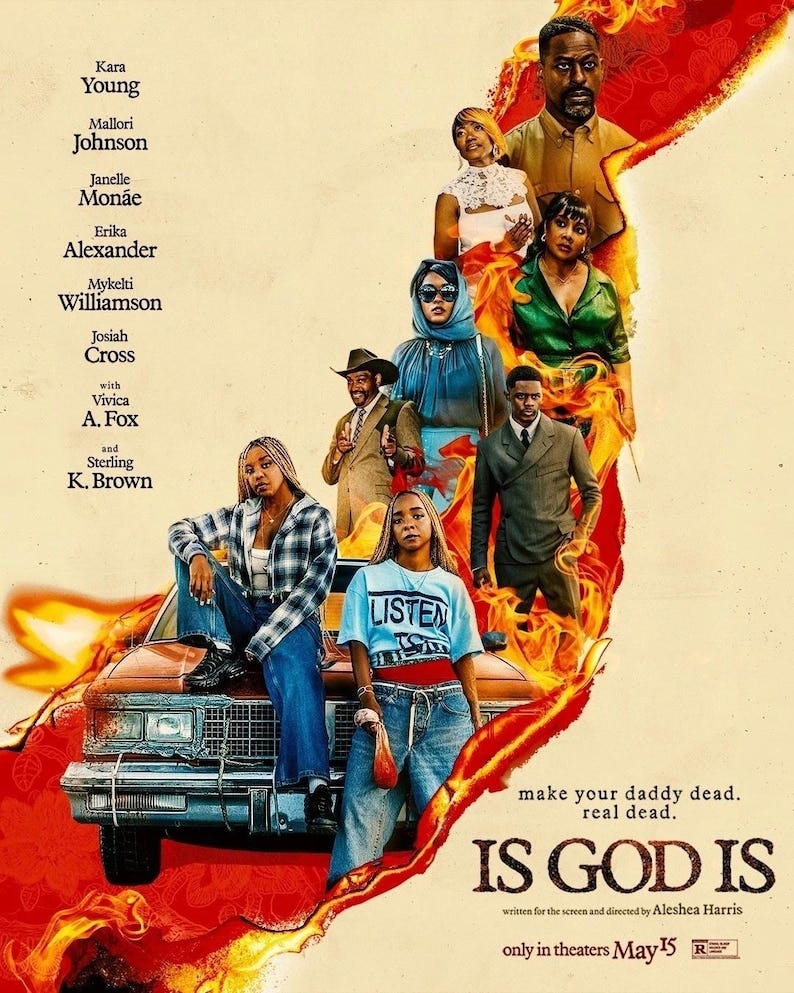
Are vengeance and justice identical, or fraternal?
That is the question I am wrestling with after watching Aleshea Harris’ directorial debut adapted from her play of the same name, Is God Is. I could talk about the significance of twins in Yoruba culture, this deeply engaging ensemble cast, or how Harris is following in the magnificent footsteps of Kasi Lemmons’ Eve’s Bayou, but instead, I want to zoom out for a moment.
While Racine, played by the indomitable Kara Walker, comes in .38 hot, Anaia, played by the tenderly captivating Mallori Johnson, is a slow, slow burn — two sides of the same coin. Personally, I identified closer with Anaia due to my own reluctance of impulsively acting on my anger, yet, I knew the power that was steeping in that kettle of hers. With Racine, I understood the lack of restraint when people have been merciless in their cruelty towards her and her sister. These sisters’ approach to handling inherited pain is an intimate look into the human animal and its limitations.
Transparently, this play (I read it a week prior to watching) and film landed in my life with uncanny timing. Life, God, Spirit, has been testing me in the arena of rage and what to do with it. The recent highly publicized events of Black femicide in the U.S. accompanying the release of this film is an eerie coupling. And even more transparently, my aforementioned rage is the product of a man abusing his power within my own family. Safe to say this story sent shockwaves through my spirit.
So, I return to this question: Are vengeance and justice identical, or fraternal? My current answer is fraternal. Borne of the same womb, but differing in execution. Without spoiling anything, we are snagged along this Kill Bill-esque journey, and as we propel alongside the hum of an engine, we witness a gruesome collection of debt owed for the crime against the girls’ mother, God (played by THEE Vivica A. Fox). No one is spared, but as spiritual law reminds us, everything has a cost. Again, no one is spared. Not even the audience.
What does vengeance cost? I think of it as one of those shady-ass payday loans that occupy the Alabama red clay I was raised on. You’re in an emergency, you can’t afford to think, and you just need to fix the problem. Your account is in the negative and capacity ceases to exist. You secure the loan and you can breathe… for the next 24 hours or so. Until you’re reminded of the UNGODLY interest rates that them folk know you can’t pay back. An irremovable stain. A scarlet letter stitched into the skin.
Then there is justice, which is imperfect but necessary. I can’t rewind the clock and stop his fist from striking my face, or me being pushed down the stairs, or the spray of spit coating my face when he barked “faggot” my direction. What I can do, is promise myself that that bullshit ends with me. That tree don’t bear no fruit. I long to invest in a trust that blesses generations long after I’ve transitioned. Faith in the long term. Initially, those little moments don’t feel like much, but then one day that memory don’t hurt as much and your chest expands a lil’ more than it used to.
Is God Is meditates on the messiness of paying for pain you didn’t purchase. The words of Kathleen Collins from her 1984 lecture at Howard University played in my mind after receiving Harris’ film. The frustrating beauty that Black folk are neither saints nor sinners. Only people. I breathe in as I feel the hands of my Aunt Frances and Great-Grandmothers Dee and Fannie Spears assuring me that Love builds while hatred perpetually undoes itself. Vengeance belongs to Them ‘cause our struggle ain’t against flesh and blood.
softly,
dev<3